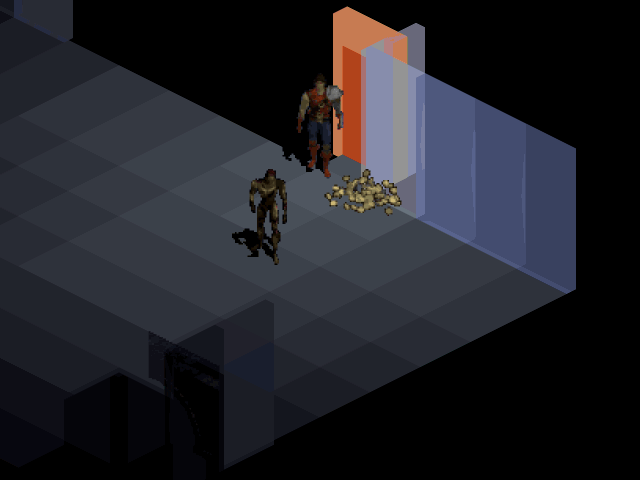
The first Cathedral pilot used a checkerboard floor and walls in simple colors. The area now receives materials from the original, while transparency copies only the region needed for each triangle. The change brings the appearance closer and reduces renderer costs in the measured cases.
The delivery in commit a783aff4 was installed on October 9, 2026, at 17:34, Brasília time, through the same Iniciar-Tristram.cmd launcher. The scope remains nine regions near the player, only on the Cathedral's standard first floor. Other floors and quest levels retain the native presentation; actors in this pilot remain sprites.
Original materials, shapes still provisional
The floor uses CEL/MIN data already prepared by the engine: a 64×32 bitmap and a coverage mask independent of color. Visual alignment was corrected without replacing the physical mesh or native selection bindings. Masonry uses strips oriented by the face and SOL source; wood comes from a small section of the door's CLX.
Repetition, donor materials, caps and faces without a reference are approximations. Shapes, heights, arches, stairs and details are unfinished. Using native materials does not constitute full artistic approval or mean that the entire floor has been reconstructed.
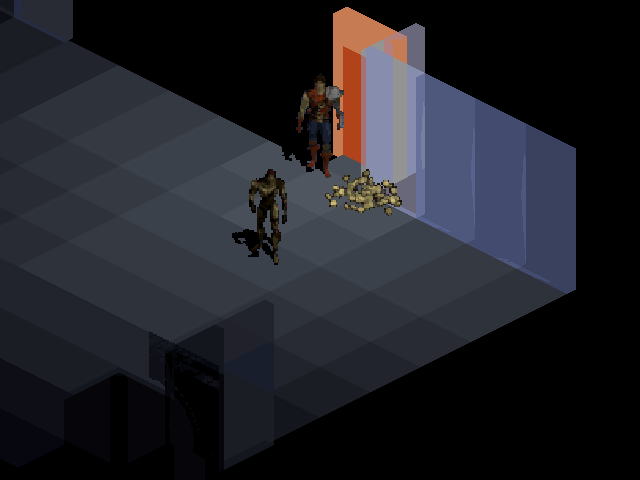
The pair below shows the same nearby technical framing, without antialiasing: before, with simple colors; after, with materials and regional copying. These are offscreen runs, with a stationary scene and partial initialization, without a HUD or a gameplay session using physical input. The visual floor changes deliberately; the before-and-after comparison does not claim equal pixels.
The following comparison forces geometry on at the original perspective, alongside the native reference. It reveals differences in coverage, walls and arches that still need review. Home continues to use the original drawing path; that return alone does not validate the reconstruction's fidelity.
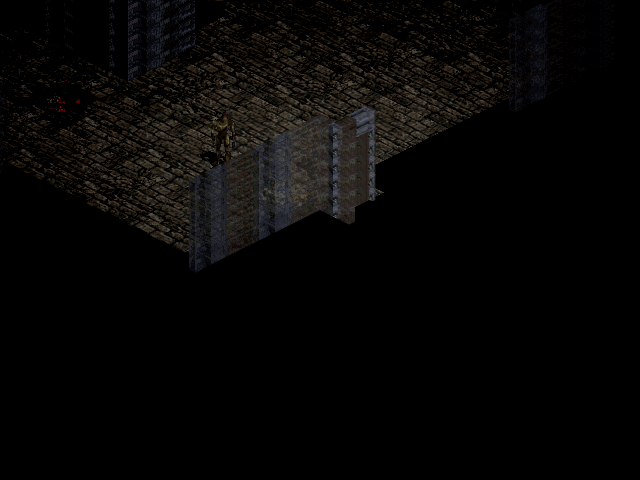
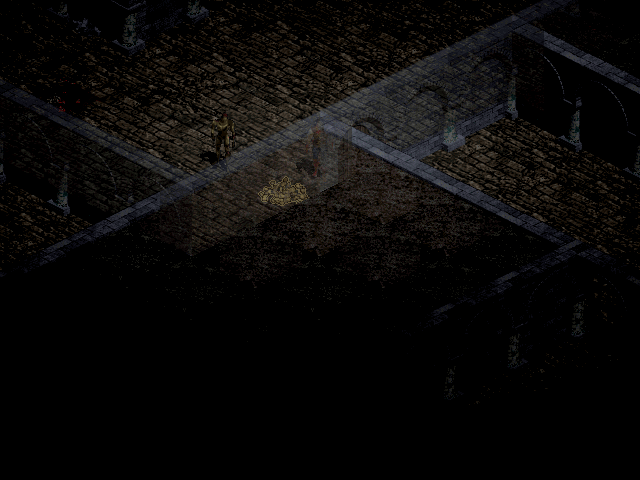
The three new PNGs retain their bytes and original 640×480 resolution, without conversion, cropping or retouching. The existing reference also remains intact.
Transparency with less work per frame
Previously, each transparent triangle saved a copy of the whole screen. The backend now copies a conservative area around the triangle, preserving order, colors, depth, selection and admission limits. The isolated A/B comparison kept nine complete buffers identical; the backend A/B comparison in the native scene preserved 12 byte-exact PNGs. This equality covers the isolated optimization: adding the materials afterward deliberately changes the image.
The measurement used a real Radeon RX 570, six pose and quality combinations, five warmups and twenty samples per case, with 156 renderer calls per phase. Logical resolution was 640×480; AA2x draws at 1280×960. Two excerpts from the warm distributions:
| Case | Before: median / p95 | Materials + regional copying: median / p95 |
|---|---|---|
| Nearby, without AA | 13.42 / 13.76 ms | 10.27 / 11.29 ms |
| Distant, AA2x | 77.73 / 79.05 ms | 65.86 / 68.64 ms |
These are wall-clock times for the renderer, including GPU waits and readback. They exclude gameplay, HUD, presentation and external native preparation; they are neither sustained FPS nor a promise of 60 FPS. Cold frames that create resources are kept separate from warm samples. The other cases and intermediate phase are in the versioned GPU record.
In the distant AA2x case, snapshot payload fell from 253,132,800 to 820,803 bytes per frame. This is the volume of the copied regions, not a measurement of total bus traffic. The GPU remained active in every sample, without CPU 3D rasterization or warm texel/LUT uploads. Commands and readback remain significant costs.
What was installed and what remains to be tested
The material gate passed 168,022 checks over 81,152 texels, compared with the native rasterizers. There were eight frames with geometry forced on and seven technical PNGs. The area's cache has 72 entries and 162,304 bytes of pixels and coverage; four warm redraws performed no new decoding. Its limits and lack of automatic eviction still need work before expanding the floor.
Recovery was checked separately on the same build: 157 harness checks, 188 contextual checks and 93 allocation checks, with four failures and immediate GPU recoveries. Ogden and Tristram passed 1,348 checks, preserving twenty byte-exact PNGs. The 290,243-byte native witness remained identical, with the map, SOL, RNG and transparency preserved. The fixture did not contain an open door: its operation was not tested.
The three installed executables have the same 6,559,744 bytes, SHA-256 929a78f6c15d7e642225c11bc035462c5d93009a87786165eddf9d48746be652. The 48 original profile files retained their contents, sizes and timestamps; only the launcher's derived receipt was renewed. There was no reduction or replacement of Tristram masters, selections or textures, payload installation, process termination or new paid operation.
The next step is to test entry, movement, combat, transitions and doors in a play session, review shapes and details, and measure commands, readback and the cache before expanding the levels. Technical captures and renderer times do not replace those tests. The versioned integration status and roadmap keep the pilot separate from the goal of rebuilding all of Diablo 1 in 3D.
Continuity update — October 9, 18:48 Brasília time (UTC−3)
Douglas reported areas where the view returns from 3D to 2D during play, without being able to identify a specific location. Revision f710f47b, installed at 18:48 through the same launcher, adds context logging to investigate this return. The specific cause has not yet been reproduced or fixed.
The continuity diagnostic records the stage, seed, position, cache and GPU state before refusal. Materials, fallback policies and limits remain the same. Accepted preparation does not announce recovery: recovery is recorded only after the complete 3D drawing has been published.
A partial technical setup passed 121 CPU checks and 196 GPU checks on the RX 570. Logical and HD images remained byte-exact; picking and depth were checked at one test point. Installation preserved the 49 current profile files, renewing only the derived receipt. These tests verify the diagnostic; they do not establish a fix for the spontaneous return, full gameplay or sustained FPS.
Wall composition remains a separate investigation: the material still repeats a MIN strip and may use a donor source. Checking its bindings does not establish the complete facade or the pixels of every face. The next step is to collect the new diagnostic and reproduce the observed refusal. There was no new benchmark; the timings and captures above still refer to revision a783aff4.