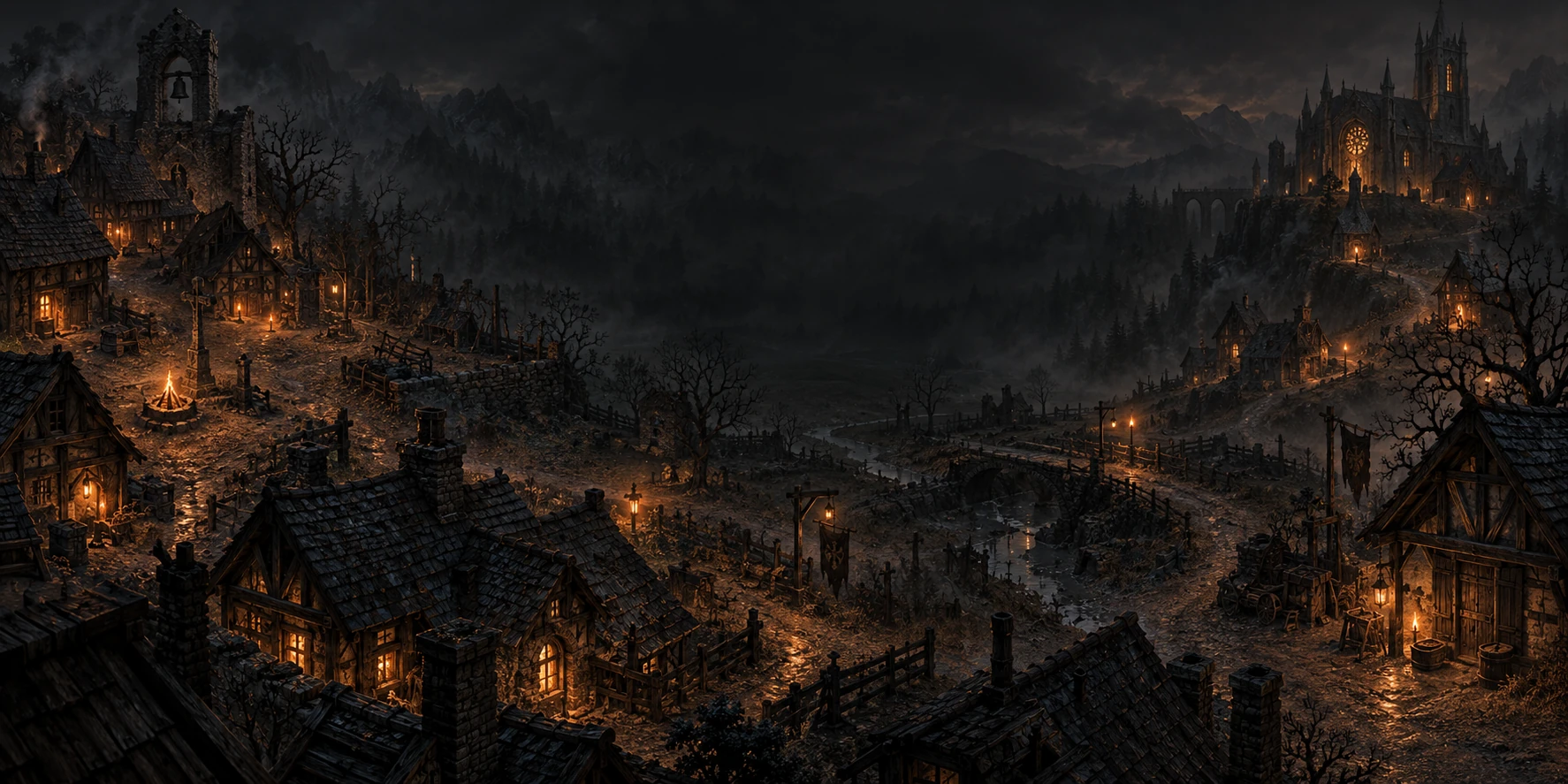
Tristram
In checkpoint b775, the 13 Meshy architecture bindings are disabled and use simpler substitutes. Masters, candidates and LOD studies are preserved. Reconstruction, materials, lighting, cameras and interactions need review.

ROADMAP
Every level is part of the goal. Tristram and the Cathedral’s first floor are in development. The order remains: the complete game in 3D, persistence and respawn, multiplayer research targeting 50–100 players, then expansion. This roadmap sets no delivery dates.
AI-generated atmospheric illustration
Windows b77562161864: Tristram, third/first person, HD HUD and a nine-region pilot on the first normal Cathedral floor. The 14 known Meshy bindings are disabled; the town uses simpler substitutes and Ogden uses the original sprite. Earlier models are preserved for review.
Loading saves or returning to a dungeon can make 3D fail and fall back to native presentation. Other floors still use the original view. Artwork, interactions and performance need work; sustained full-game FPS has not been established.
R12 is a browser test served only on the development PC. It is not a public web version. An installable public package still needs validation; private changes are not presented as delivered.
Broader game development is on hold. Final preparation does not constitute a new published build; there is no promised full-game completion date.
In checkpoint b775, the 13 Meshy architecture bindings are disabled and use simpler substitutes. Masters, candidates and LOD studies are preserved. Reconstruction, materials, lighting, cameras and interactions need review.
The 3D pilot is installed locally and Douglas tested two seeds. The October 10 update fixes known grates, false visual walls at light supports and item names in 3D. This does not complete the floor or the entire Cathedral: general materials, 2D fallback, camera behavior, gameplay and artwork remain under review. Other floors and quest levels retain native presentation.
Complete every level of the Cathedral, Catacombs, Caves and Hell, including characters, enemies, objects, animations, effects and game content. Each environment requires implementation, comparison with the original and testing. Tristram is the first stage, not the limit of the project.
After completing and stabilizing Diablo 1, validate a persistent world, loot respawn and renewal of objects, containers and NPC inventories. Saves, restart, reconnection, quests and duplication prevention require testing. Intervals will be configurable: 30 minutes is only an example to define and test.
The 50–100-player target depends on persistence, networking architecture and validation of authority, synchronization and capacity. This is future research, without a delivery date or available capacity. The current build is offline.
Player names and levels, chat bubbles and friends belong to the future multiplayer phase. Proximity voice remains research, with separate moderation, privacy and cost decisions. These features are not implemented yet.
Plan new explorable surface regions and new levels after the multiplayer phase. Progression, generation, saves and compatibility require a separate proposal and pilot. A decorative horizon and fog are already integrated as provisional visuals in Tristram; day/night remains future work. None of these features expands the playable terrain.
The states below distinguish private code, isolated pilots and future features. None represents a new public version ready to install.
Character, Quests, Inventory and Spellbook, with a real minimap and exploration fog, have code prepared in a private candidate. Native tests have not run yet; integration and gameplay review remain pending.
In first person, a click should prioritize a nearby aimed-at item, door, chest or object within native range and line of sight before attacking. The helper is prepared privately; integration is pending. It includes no automatic walking and applies only to first person.
The 2K Warrior is a private candidate with 52 bones, hands and fingers, without a weapon, shield or clips, final approval or installation. Inventory and local hand derivation are in preparation; synchronizing weapons and equipment with combat depends on approved assets and a still-missing 3D weapon. Ogden’s earlier rig is preserved as historical work; b775 uses his native sprite.
Players are to have a name, level and HP above their heads, without a self-label in first person. For monsters, study only the native bar when aiming; permanent indicators on every monster are outside the request. Implementation and validation are still required.
The top compass should follow camera orientation and show only discovered points. The pilot starts with stairs, preserving the seed and floor context. The 3D registry and objectives belong to a later stage.
The contract and isolated pilot must swap item width and height, preserve attributes and allow rollback. Before applying it, validate saves, networking, stash, trades, shops and equipment. Rotating the image alone does not resolve placement or compatibility.
Standalone, CPU guard and limited headless tests passed, but end-to-end validation with the 13 models is still missing. Applying changes to the game, canonical data, visual masks, collision, picking and a compatible capture remain pending. Editing and applying houses through the usual launcher still requires that proof.
The smallest adaptation is to simplify the existing Godot editor and gizmos. A dedicated app or a 2D floor plan would require new implementation. The choice depends on feasibility and a decision; it does not automatically take priority over completing the game, and has no promised date or RAM requirement.
IN PREPARATION · NO VALIDATED PUBLIC PACKAGE
The public package and Panvia integration still need validation. For now, GitHub provides source and build instructions. A future installation must preserve saves, settings and rollback.
A local installation and public code do not establish a distributable public build. The Diablo 3D package and Panvia installation/update integration must be confirmed before offering an install button. Original game data remains outside distribution; the published license remains the reference.
Architectural silhouettes and hidden faces, materials, characters and occlusion. Automated generation helps the process, but every object needs human review and actual comparisons.
Historical native-mode comparisons retain the version in which they were made. Validating geometry requires reviewing the active mesh at the same camera pose.
This project’s planned expansion to Diablo 2 was cancelled and is outside this roadmap. The priority is the complete Diablo 1 game, followed by multiplayer and then expansion.
Read the versioned roadmap on GitHub ↗